By Natasha Ghassany & Sam Nyamwange

Good sexual health goes way beyond avoiding disease — It is a state of complete physical, mental and social well-being in all matters relating to the reproductive system and one’s sexuality. It implies that people are able to have a satisfying and safe sex life, the capability to reproduce, and the freedom to decide if, when, and how often to do so. In a world where many young people lack information or access to services, products or resources that are necessary for good sexual health, it is important to provide interventions that respond to the realities of young people in all their diversity.
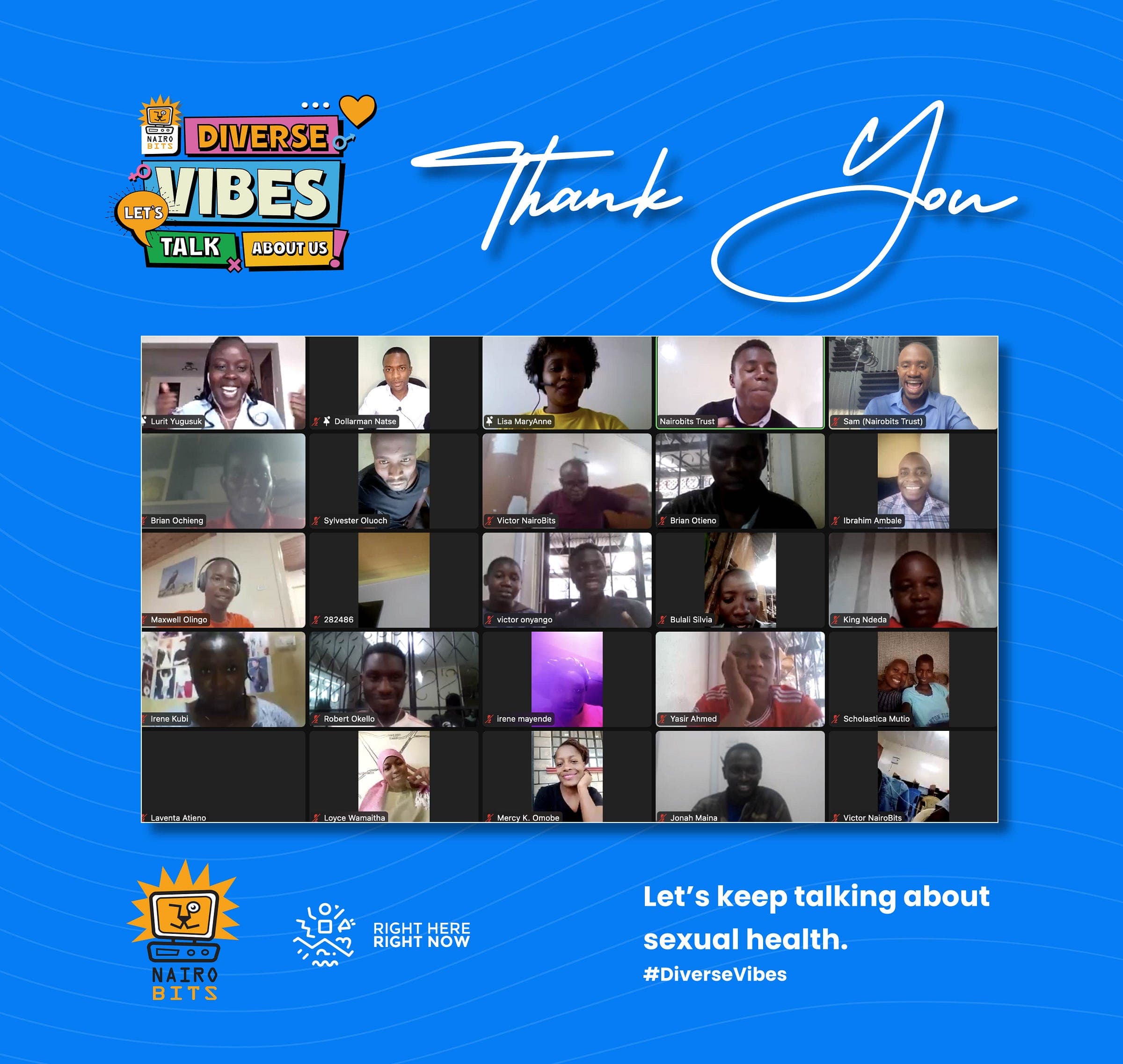
As such, NairoBits Trust has curated #DiverseVibes, a youth-centred and youth-led digital campaign that seeks to have honest assorted conversations around SRHR Information and education and Gender Justice and what this means for societies, with a particular lens on young people. As part of the campaign, the #DiverseVibes team put together an expert chat on Sexual Health. The chat featured young experts in the sexual reproductive health and rights field; Dollarma Fatinato (Youth Coordinator @ The Center for the Study of Adolescence) Lisa Mary Anne (Team Lead @ Mothers and Daughters Care Initiative) and Lurit Yugusk (Acuity Programs Lead @NairoBits Trust).
The riveting and thought-provoking discussion spanned key aspects of sexual health, what it means for young people and how it affects their political, social & economic lives. Central to the discussion was the need for acknowledgement and respect that sexual health is a phenomenon that we all share and that sexuality is a natural part of life and involves more than sexual behaviour. Based on this understanding, participants started to appreciate sexual health as a great contributor to the overall health & well-being of each individual.
As they demystified what sexual health entails, the key discussions focussed on sexuality diversities, Comprehensive Sexuality and Education (CSE) provided by different organisations, Antenatal, childbirth & postnatal care, contraceptive use, issues around abortion, Gender-Based Violence (GBV) and Intimate Partner Violence (IPV), Sexually Transmitted Infections (STIs), infertility and so on.
In thinking about the state of sexual health (and their rights) in Kenya, the panellists agreed that the country has made substantial strides in creating a supportive legal framework for SRHR including within the Constitution of Kenya. Article 43 (1) (a) guarantees each Kenyan citizen the right to access the highest attainable standard of health including reproductive health care. Further, Kenya has many legal provisions that guarantee access to high-quality Sexual Health care including the Sexual Offences Act, Anti-FGM Act, National Health Policy 2012–2030 etc. which provide clear information and ramifications of offences. However, there are pertinent issues that curtail the proper implementation of the policies including stigma, capacity of healthcare workers, cultural barriers, and resources determine how young people access SRHR info and products.
As they reflected about their experiences working in the Sexual health field with young people, the experts gave some interesting stories.

This was first expert chat in the #DiverseVibes series. Learn more about #DiverseVibes and join us for the next call on Access to SRHR Info & Products.