Story by Robert Mutahi
Creative support/Designer-NairoBits Trust
“Huoni aibu wewe ndio mwanaume hapo pekee yako?” “Aren’t you ashamed to be the only man there?”
“Wafunze wasichana kuwa na adabu na kunyenyekea na hawataumizwa” “Teach women to behave and submit and they won’t be harmed.”
“Waambie waache kwenda kwa BNB’s “ “Tell them to stop going to BNB’s.”
“Hata wanaume wanauliwa” “Even men are being killed.”
“Wanawake watafute pesa zao” “Women should earn their own money.”
“Nani anatetea wanaume?” “Who is defending men?”
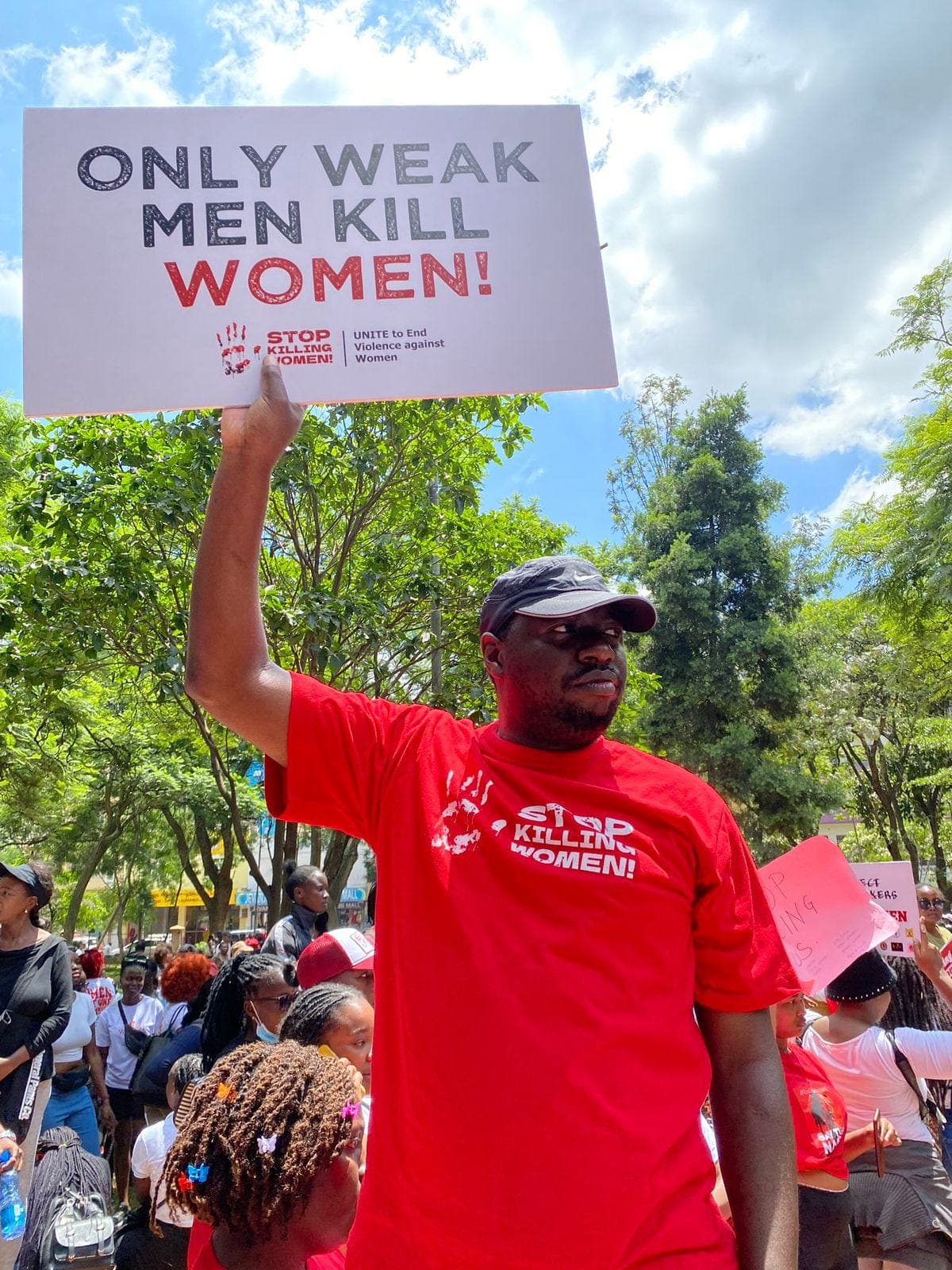
These are some of the sentiments I encountered on my way home after the march and online when my image and message were carried across many social media accounts.
I recently took part in a women’s march advocating for the end of femicide, and I received both applause and criticism in equal measure. Some disapproved, suggesting I was delving into feminist matters, while others commended my bold presence.

Despite my deep involvement in the campaign’s development through NairoBits Trust and its partner, Christian Aid, I want to highlight that my participation extended beyond the assigned duties and stemmed from more significant reasons than simply having a mother, three sisters, and a daughter. It was driven by my moral convictions. My goal was to articulate my stance, clarify my position, and unequivocally assert that I do not align with the men leading the victim-blaming movement. They do not speak for me!
Even though I see myself as a modern man with a solid traditional foundation, I still think that males ought to protect women constantly.

However, this raises an important question: Why should men defend women? Why are men unable to make a contribution to creating an environment of safety in which women can flourish? The key to finding a solution is realizing that years of unchecked harassment, bullying, physical abuse, and eventually murder lead to violence against women. This violence is caused by a number of reasons, such as government, economic inequality, and culture. While addressing these issues improves the situation, it is still necessary to look at our social structure and value systems.
The harsh reality is that men are not only causing harm to women but also to other men. It’s not a competition but a warning — if the current trend continues, men will soon find themselves trying to save themselves from their own actions. Breaking free from this destructive cycle necessitates acknowledging that men who disregard the vulnerable contribute to a harmful pattern that is challenging to escape.
I’d like to address men directly in this context. Although history serves as a valuable teacher, it’s a bad parent.
A study of failed states and societies reveals that men frequently bear responsibility for causing harm and violating the rights of the most vulnerable. This emphasizes the vital necessity for men to be attentive because it is crucial for MEN to comprehend that those who ignore the most vulnerable in society lack concern for ANYTHING! MEN who lack concern for ANYTHING also demonstrate a lack of care for their fellow MEN! So no MAN is safe if WOMEN are not safe!

To those men who persistently questioned me that day, taunting me and throwing statistics my way, I want to clarify — this is a case of statistical bias. You’re presenting facts but framing them to suit your narrative. We don’t deny the reality that men are also victims of violence, but that shouldn’t hinder them from advocating for justice.
The key is not to remain silent and only speak up when women take a stand for themselves. Everyone should actively engage in addressing the issues affecting both men and women.
Let me clarify unequivocally: both men and women face fatalities. More men are involved in perpetrating violence against both men and women compared to women engaging in such actions. There are more male victims of violence than female victims. A higher number of women experience violence inflicted by men based on their gender (femicide). Conversely, a smaller number of men are victims of violence by women based on their gender (androcide).
Therefore, it is unfair to minimize the efforts women make to advocate for a secure environment for themselves. Men have a responsibility to actively support the creation of a safe environment for women as well as to vehemently condemn acts of violence committed by males against other men.
Both genders must refrain from simply exchanging accusations and instead engage in a conversation about how our value systems, poor governance, cultural factors, and economic status contribute to the culture of femicide. Finally, men should enter this conversation with empathy and a readiness to unlearn.